

Recent Updates
All Countries
All Countries
Afghanistan
Albania
Algeria
American Samoa
Andorra
Angola
Anguilla
Antarctica
Antigua and Barbuda
Argentina
Armenia
Aruba
Australia
Austria
Azerbaijan
Bahamas
Bahrain
Bangladesh
Barbados
Belarus
Belgium
Belize
Benin
Bermuda
Bhutan
Bolivia
Bosnia and Herzegovina
Botswana
Bouvet Island
Brazil
British Indian Ocean Territory
Brunei Darussalam
Bulgaria
Burkina Faso
Burundi
Cambodia
Cameroon
Canada
Cape Verde
Cayman Islands
Central African Republic
Chad
Chile
China
Christmas Island
Cocos (Keeling) Islands
Colombia
Comoros
Congo
Cook Islands
Costa Rica
Croatia (Hrvatska)
Cuba
Cyprus
Czech Republic
Denmark
Djibouti
Dominica
Dominican Republic
East Timor
Ecuador
Egypt
El Salvador
Equatorial Guinea
Eritrea
Estonia
Ethiopia
Falkland Islands (Malvinas)
Faroe Islands
Fiji
Finland
France
France, Metropolitan
French Guiana
French Polynesia
French Southern Territories
Gabon
Gambia
Georgia
Germany
Ghana
Gibraltar
Guernsey
Greece
Greenland
Grenada
Guadeloupe
Guam
Guatemala
Guinea
Guinea-Bissau
Guyana
Haiti
Heard and Mc Donald Islands
Honduras
Hong Kong
Hungary
Iceland
India
Isle of Man
Indonesia
Iran (Islamic Republic of)
Iraq
Ireland
Israel
Italy
Ivory Coast
Jersey
Jamaica
Japan
Jordan
Kazakhstan
Kenya
Kiribati
Korea, Democratic People's Republic of
Korea, Republic of
Kosovo
Kuwait
Kyrgyzstan
Lao People's Democratic Republic
Latvia
Lebanon
Lesotho
Liberia
Libyan Arab Jamahiriya
Liechtenstein
Lithuania
Luxembourg
Macau
Macedonia
Madagascar
Malawi
Malaysia
Maldives
Mali
Malta
Marshall Islands
Martinique
Mauritania
Mauritius
Mayotte
Mexico
Micronesia, Federated States of
Moldova, Republic of
Monaco
Mongolia
Montenegro
Montserrat
Morocco
Mozambique
Myanmar
Namibia
Nauru
Nepal
Netherlands
Netherlands Antilles
New Caledonia
New Zealand
Nicaragua
Niger
Nigeria
Niue
Norfolk Island
Northern Mariana Islands
Norway
Oman
Pakistan
Palau
Palestine
Panama
Papua New Guinea
Paraguay
Peru
Philippines
Pitcairn
Poland
Portugal
Puerto Rico
Qatar
Reunion
Romania
Russian Federation
Rwanda
Saint Kitts and Nevis
Saint Lucia
Saint Vincent and the Grenadines
Samoa
San Marino
Sao Tome and Principe
Saudi Arabia
Senegal
Serbia
Seychelles
Sierra Leone
Singapore
Slovakia
Slovenia
Solomon Islands
Somalia
South Africa
South Georgia South Sandwich Islands
Spain
Sri Lanka
St. Helena
St. Pierre and Miquelon
Sudan
Suriname
Svalbard and Jan Mayen Islands
Swaziland
Sweden
Switzerland
Syrian Arab Republic
Taiwan
Tajikistan
Tanzania, United Republic of
Thailand
Togo
Tokelau
Tonga
Trinidad and Tobago
Tunisia
Turkey
Turkmenistan
Turks and Caicos Islands
Tuvalu
Uganda
Ukraine
United Arab Emirates
United Kingdom
United States
United States minor outlying islands
Uruguay
Uzbekistan
Vanuatu
Vatican City State
Venezuela
Vietnam
Virgin Islands (British)
Virgin Islands (U.S.)
Wallis and Futuna Islands
Western Sahara
Yemen
Zaire
Zambia
Zimbabwe
-
U.S. Refugee Program for Afrikaner the Policy: In early 2025, the U.S. launched an immigration carve-out specifically for white South African minorities. It was justified by the administration's claims that white South African farmers face systemic violence, state-backed persecution, and a "genocide" tied to land redistribution policies.Admissions Data: The administration raised the annual U.S. refugee cap, prioritizing the Afrikaner exception. Consequently, virtually all refugees admitted into the United States have been white South Africans.Controversies: The prioritization of Afrikaners has sparked widespread political and international debate. The South African government denies the claims of genocide or anti-white discrimination, viewing the resettlement programs as politically motivated. Human rights groups have also criticized the program for stranding thousands of other displaced persons—including those fleeing war and persecution in other parts of the world.U.S. Refugee Program for Afrikaner the Policy: In early 2025, the U.S. launched an immigration carve-out specifically for white South African minorities. It was justified by the administration's claims that white South African farmers face systemic violence, state-backed persecution, and a "genocide" tied to land redistribution policies.Admissions Data: The administration raised the annual U.S. refugee cap, prioritizing the Afrikaner exception. Consequently, virtually all refugees admitted into the United States have been white South Africans.Controversies: The prioritization of Afrikaners has sparked widespread political and international debate. The South African government denies the claims of genocide or anti-white discrimination, viewing the resettlement programs as politically motivated. Human rights groups have also criticized the program for stranding thousands of other displaced persons—including those fleeing war and persecution in other parts of the world.0 Comments 0 Shares 51 Views 0 ReviewsPlease log in to like, share and comment!
-
-
-
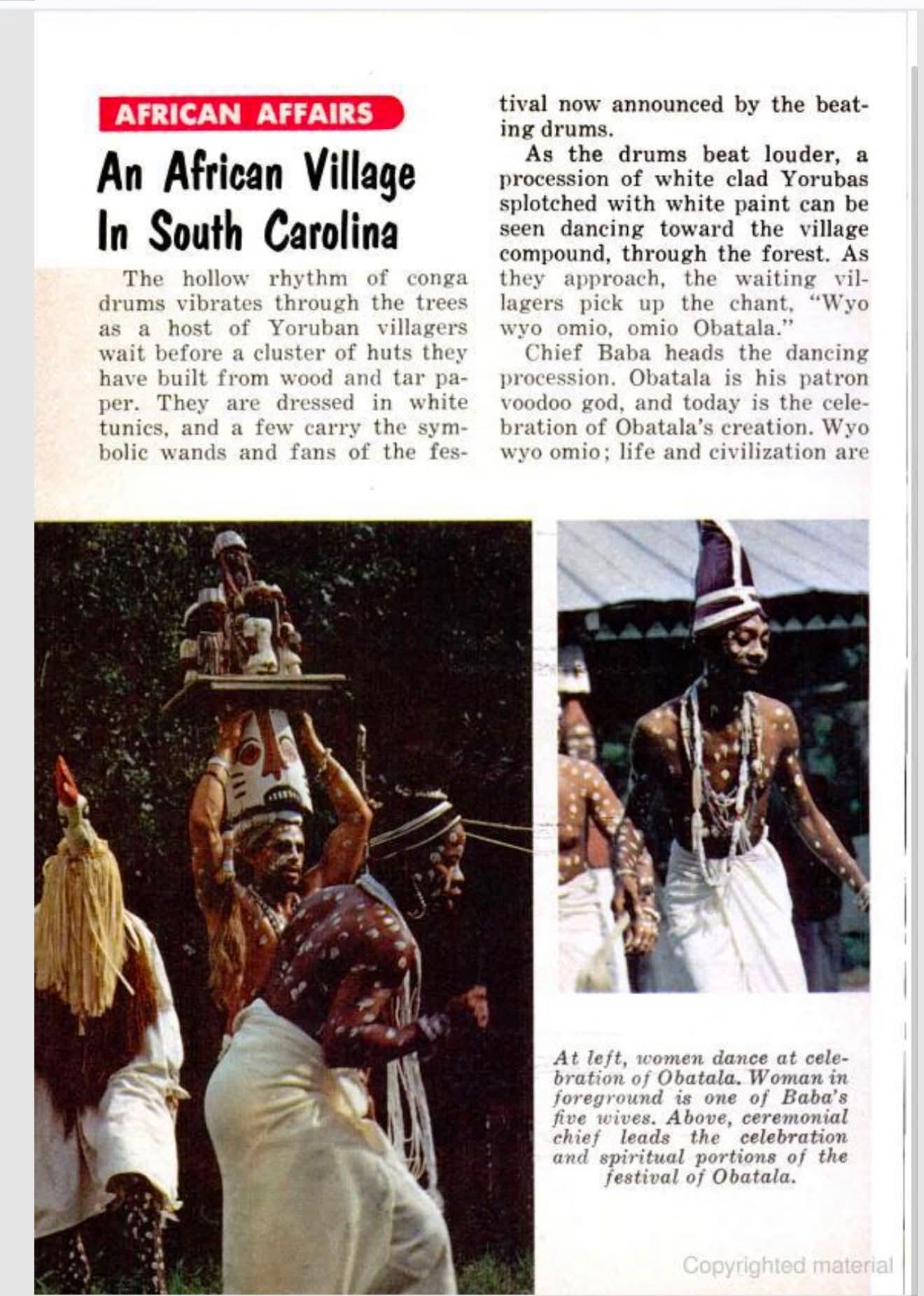
Salewa Omito Olamina Reminiscing....i grew up in an African village in the swamps of South Carolina, in the 1970s, Oyotunji, from the age of two till eleven....we had no running water...no electricity...none of the so called modern conveniences, my father built my house by hand with the help of other men of the town. My mother sewed all of me and my brothers clothing (summer and winter wear)...i was never in Western clothing. My daily chores, aside from minding my three younger brothers and tending to their needs, much like a second mother, i had to make sure there was fire wood for cooking and bathing...assist my mother with the home and kitchen duties, which was mainly...keeping an eye on my baby brothers...my brothers over the age of seven were with the men building up the town daily ( much like day labor) and in the winter chopping trees for fire wood to keep the home warm. By the age of seven i had added duties, which included now school, homework, women societal duties and p...Salewa Omito Olamina Reminiscing....i grew up in an African village in the swamps of South Carolina, in the 1970s, Oyotunji, from the age of two till eleven....we had no running water...no electricity...none of the so called modern conveniences, my father built my house by hand with the help of other men of the town. My mother sewed all of me and my brothers clothing (summer and winter wear)...i was never in Western clothing. My daily chores, aside from minding my three younger brothers and tending to their needs, much like a second mother, i had to make sure there was fire wood for cooking and bathing...assist my mother with the home and kitchen duties, which was mainly...keeping an eye on my baby brothers...my brothers over the age of seven were with the men building up the town daily ( much like day labor) and in the winter chopping trees for fire wood to keep the home warm. By the age of seven i had added duties, which included now school, homework, women societal duties and p...0 Comments 0 Shares 2K Views 0 Reviews
-
-
https://dailygalaxy.com/2026/04/knoll-brothers-photoshop-creation-story/
DAILYGALAXY.COMIn 1987, a Student Set Out to Fix a Mac Problem. The Code Spiraled Out of Control, and He Ended up Creating “Photoshop”A routine display fix on a 1987 Macintosh mutated into an unwieldy codebase. Industry doors shut. Then a single meeting at Adobe altered software history.0 Comments 0 Shares 2K Views 0 Reviews -
-
Rape of A NationIn 1897, the British "Punitive Expedition" looted an estimated 3,000 to 5,000 artifacts from the Kingdom of Benin (modern-day Nigeria). At the time, the British did not "buy" these items; they were seized as "spoils of war" to offset the costs of the military campaign. Once the art reached London, it was sold through various channels, and its financial "value" has skyrocketed over...0 Comments 0 Shares 6K Views 0 Reviews
-
-
Thomas fullerThomas Fuller African slave and mathematician 1710-1790 In most discussions of people with extraordinary powers of mental calculation, there is some mention of Thomas Fuller, an African, shipped to America in 1724 as a slave at the age of 14. He was born in 1710 Africa somewhere between present day Liberia and Benin. Late in his life his remarkable powers of calculation made him a...0 Comments 0 Shares 5K Views 0 Reviews
-
Thomas fullerThomas Fuller African slave and mathematician 1710-1790 In most discussions of people with extraordinary powers of mental calculation, there is some mention of Thomas Fuller, an African, shipped to America in 1724 as a slave at the age of 14. He was born in 1710 Africa somewhere between present day Liberia and Benin. Late in his life his remarkable powers of calculation made him a...0 Comments 1 Shares 7K Views 0 Reviews
-
https://youtu.be/XVnRAWkyP5M?si=ED2HrQ5k_DV5__VV
1 Comments 0 Shares 5K Views 0 Reviews

More Stories